Evening anxiety used to be my nightly unwelcome guest. No matter how calm my day had been, as soon as the lights dimmed and the long to-do list finally paused, my mind would spool through worries—things I’d said, emails I’d forgotten, the endless what-ifs. Over time I learned that waiting for my brain to “settle down” rarely worked. What did help was creating a small, intentional bedside kit: five simple items that interrupt the anxious loop and give me something practical and grounding to do when my thoughts start racing.
Below I’ll share the five items I keep beside my bed, why each one works (backed by brief evidence or theory), and how I use them in real evenings. These aren’t magic fixes, but together they form a tiny toolkit that helps me move from spiralling to settling—often within 10–20 minutes.
How a bedside kit actually reduces evening anxiety
Before listing the items, a quick note on the “why.” Evening anxiety thrives on uncertainty and rumination—repetitive thinking that feels like problem-solving but usually isn’t. The bedside kit uses three simple mechanisms to counter that:
Now onto the five items I recommend keeping in a neat little box or tray on your bedside table.
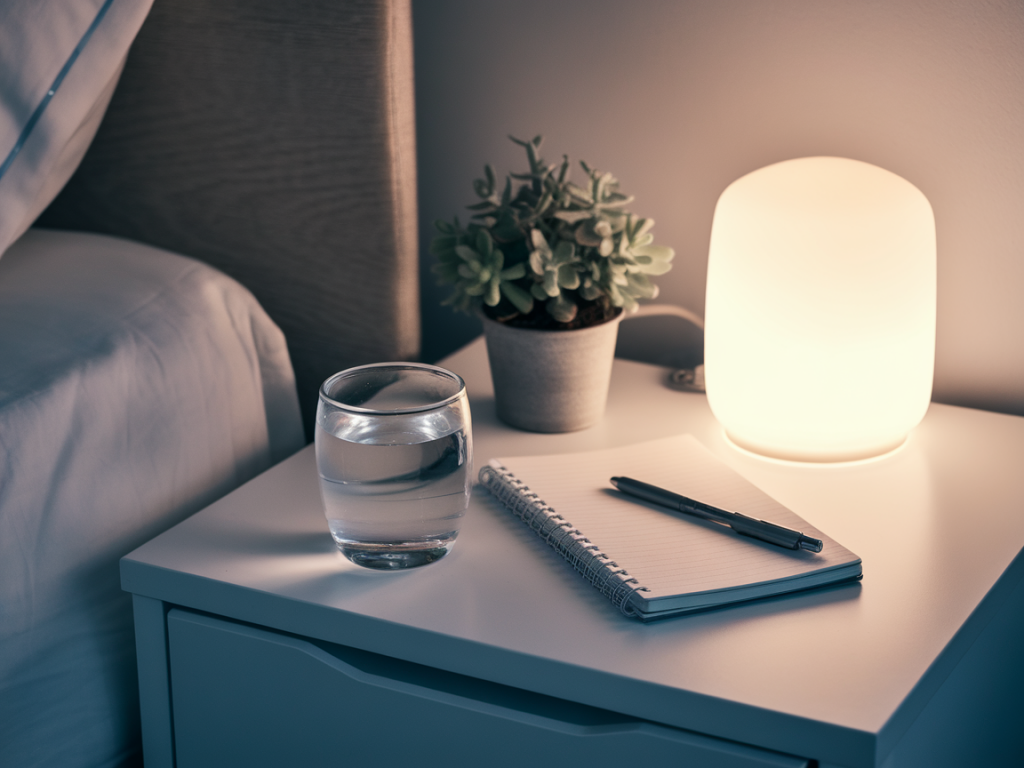
Item 1 — A small notebook and pen
Why it helps: Writing has a double benefit. First, it’s a place to offload worries and obsessive thoughts—a technique supported by research on expressive writing and worry time. Second, it’s a practical place to jot a short, specific plan for tomorrow, which reduces the brain’s urge to rehearse tasks overnight.
How I use it: When I notice a spiral, I set a timer for five minutes and write everything on my mind without censoring. Then I take 60 seconds to write three clear, actionable items I’ll do tomorrow (not a long to-do list—just the essentials). That small act of specificity often convinces my mind that the problem is “handled.”
Item 2 — A tactile object (smooth stone, worry bead, or stress ball)
Why it helps: Tactile stimulation is grounding. Touch can anchor you in the present moment and provide sensory input that overrides anxious mental loops. There’s also evidence that repetitive tactile motion (like squeezing or rubbing a bead) reduces tension and improves focus.
How I use it: I keep a polished river stone and a small mala bead bracelet by my lamp. When I feel anxious, I close my eyes, feel the stone between my fingers, and trace the beads slowly with my thumb while breathing. The repetition and texture give my body something to do other than tense up around the thought.
Item 3 — A simple breathing prompt (card with a short practice or a small breathing device)
Why it helps: Breath-focused practices change physiology. Slower, controlled breathing signals safety to the nervous system and can lower cortisol and heart rate. Even brief 3–5 minute breathing exercises have measurable calming effects.
How I use it: My kit contains a small note card with two short practices: 4–6–8 breathing (inhale 4, hold 6, exhale 8) and box breathing (inhale 4, hold 4, exhale 4, hold 4). Sometimes I also use a small, battery-operated breathing pacer (available from brands like Wellue or Philips) that gives gentle visual cues. I aim for three to five cycles—enough to feel my shoulders release.
Item 4 — A calming scent or roll-on essential oil
Why it helps: Smell is directly linked to brain regions involved in emotion and memory, so a familiar, calming scent can quickly change mood. Lavender, bergamot, and chamomile have been shown in studies to reduce anxiety and improve sleep quality. A subtle roll-on makes this accessible and safe to use on the wrist or temples.
How I use it: I keep a lavender-bergamot roll-on (I often use smaller blends from Neal’s Yard or a local aromatherapy brand) and dab a little on my inner wrists. The scent is gentle, not overpowering. I combine it with a slow breathing cycle, which amplifies the calming effect. If you’re sensitive to smells or live with partners who are, choose an unscented tactile option instead.
Item 5 — A 1–2 minute “reality-check” card
Why it helps: Anxiety exaggerates worst-case scenarios. A reality-check card is a brief, compassionate script that helps you test anxious thoughts against facts. Cognitive-behavioral approaches use this method: mapping evidence for and against a worry, then arriving at a balanced, more likely outcome.
How I use it: My card has three prompts: “What’s the evidence this will happen?”, “If it did, what’s a workable next step?”, and “How likely is it on a scale of 0–100?” When an image of catastrophe rises, I read the card and answer the prompts in one or two sentences. This often slides my perspective toward something manageable.
Putting the kit into practice — a simple evening ritual
Here’s a short ritual I follow that uses the five items. It’s flexible—adapt it to 5 minutes or 20.
Most nights this sequence dissolves the tension enough for me to move into a wind-down activity—reading a few pages of a book, listening to a short guided sleep meditation, or doing a gentle stretch. On harder nights it doesn’t eliminate anxiety completely, but it gives me a compassionate structure so panic doesn’t hijack my sleep.
Practical tips and boundaries
If you try a bedside kit, start with one or two elements and add more as it feels helpful. For me, having something to do—tactile, sensory, and practical—changed evenings from battlegrounds into manageable, even tender, moments of care.