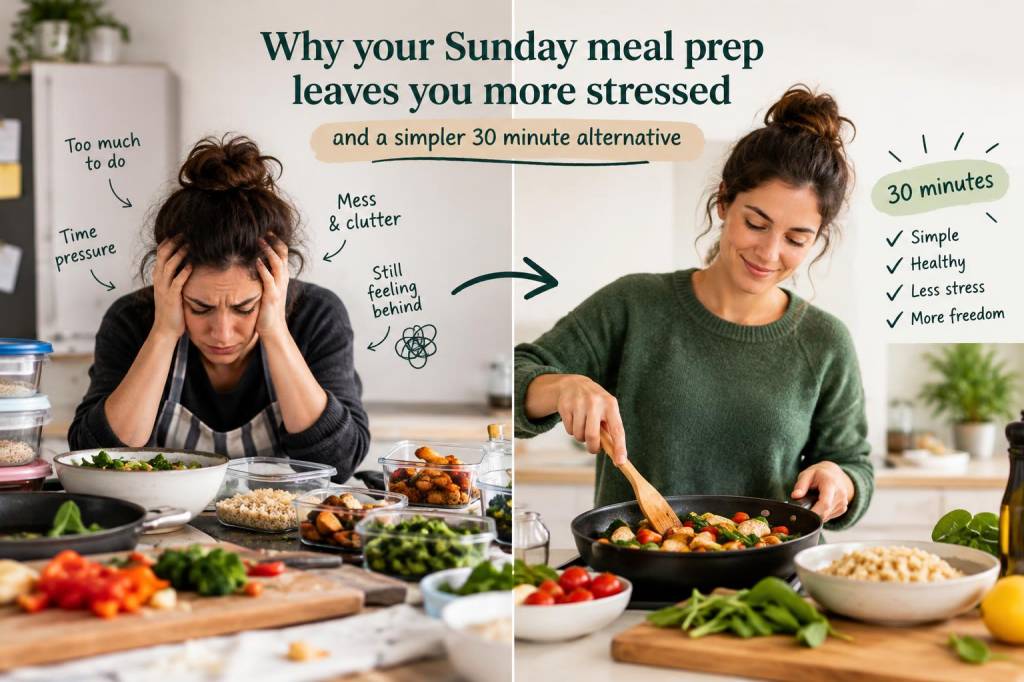
I used to think Sunday meal prep was a sign I had my week under control. Containers lined up, chopped vegetables, grains cooling on the counter, sauces portioned into little jars, and a quiet sense of pride that lasted exactly until Sunday evening. Then Monday arrived. I would open the fridge, stare at a row of meals I no longer wanted, and feel a familiar wave of stress: Did I make enough? Will this still taste good on Wednesday? Why does something meant to make life easier feel like another project?
If that sounds familiar, I want to reassure you that nothing is wrong with you. For a lot of people, Sunday meal prep becomes stressful because it tries to solve every meal for several days at once. Real life is messier than that. Appetite changes, plans shift, leftovers get ignored, and a perfectly organized system can start to feel like a second job. I have learned that a calmer approach often works much better: a simple 30-minute reset that gives me flexibility instead of pressure.
Why meal prep starts feeling heavy
Meal prep can become overwhelming for a few reasons. First, it often asks for a large block of energy on one day, usually when many people are already trying to rest. Second, it creates a false sense of certainty. We imagine that if we prepare everything in advance, we will eat perfectly all week, but actual weeks are rarely that tidy. Third, meal prep can turn into a perfection task. Once I started trying to make every container look polished, match macros, stay fresh, and suit every mood, it stopped feeling like care and started feeling like performance.
I also think meal prep can trigger decision fatigue in a sneaky way. Instead of reducing choices, it can create a new set of them: Which recipes should I pick? What if I get bored? What if I cook too much? What if I do not eat what I made? That mental load matters. Food is meant to nourish us, not occupy our entire weekend.
Another issue is that many meal prep plans assume a very neat life. They do not always account for late meetings, changing hunger, family schedules, social plans, or days when you simply want soup instead of a grain bowl. When a system cannot bend, it tends to break.
What I wanted instead
I began looking for a method that would still support my nutrition without demanding a full kitchen takeover. I wanted meals that were easy to assemble, not meals that required a lengthy Sunday routine. I wanted food that could adapt if my mood changed. I wanted enough structure to avoid scrambling, but not so much structure that I felt trapped by my own planning.
That is where my 30-minute alternative came in. I do not think of it as meal prep in the classic sense. I think of it as a fridge reset. It is a short, realistic session that gives me building blocks for the next few days. Instead of preparing seven identical lunches, I prepare ingredients I can mix and match.
This shift changed everything for me. My food felt fresher. My fridge looked calmer. My evenings felt lighter. Most importantly, I stopped associating nourishment with a sense of obligation.
What I do in 30 minutes
I keep my process simple on purpose. The goal is not to create a perfect weekly menu. The goal is to make future meals easier. Here is the rhythm I use when I want a low-stress reset:
- I check what is already in my fridge, freezer, and pantry.
- I choose one protein, one grain or starch, and two or three vegetables.
- I make one sauce or dressing that can work in more than one meal.
- I wash fruit, chop a few basics, and portion snacks.
- I leave room for leftovers, takeout, or spontaneous meals.
That is enough. I do not need a full menu. I do not need a detailed spreadsheet. I just need a few useful pieces that make it easier to eat well without thinking too hard.
For example, I might roast a tray of vegetables, cook rice or quinoa, prepare eggs, and mix a simple yogurt herb sauce. From there, I can build a bowl, a wrap, a salad, or a quick plate with whatever else I have. If I am in a breakfast mood, the same ingredients may become toast toppings or a savory egg plate. Flexibility is what keeps me consistent.
What a 30-minute reset can look like
When I have half an hour, I like to divide it into small, realistic steps. This keeps me from drifting into overthinking or overcooking. I usually move like this:
| Minute range | Focus | Example |
|---|---|---|
| 0 to 5 | Check supplies | Look at fridge, freezer, and pantry |
| 5 to 10 | Choose basics | Pick one protein, one starch, two vegetables |
| 10 to 20 | Cook or assemble | Roast vegetables, boil eggs, cook grains, mix sauce |
| 20 to 25 | Prep extras | Wash fruit, portion nuts, slice cucumbers, make snacks |
| 25 to 30 | Set up use | Place items at eye level, label containers if needed |
That table may look simple, but simplicity is exactly what makes it sustainable. I am not trying to cook every meal in advance. I am creating enough structure to support myself without draining my energy.
What I keep on hand for easy meals
I like to stock ingredients that can work in many combinations. That way, I can respond to my actual appetite instead of forcing myself into a fixed plan. My staples often include:
- Cooked rice, quinoa, oats, or potatoes
- Eggs, Greek yogurt, tofu, beans, chicken, or salmon
- Cherry tomatoes, cucumbers, leafy greens, carrots, peppers, or broccoli
- Fruit such as berries, apples, bananas, or citrus
- Nuts, seeds, hummus, cheese, or avocado
- A simple dressing, pesto, tahini sauce, or vinaigrette
With that mix, I can make something satisfying without needing a big recipe every time. A bowl can become a lunch. A wrap can become a snack. A salad can become dinner if I add enough texture and protein. I like having options that feel good without requiring much effort.
Why flexibility helps more than perfection
I used to believe good nutrition meant being highly organized. Now I think good nutrition often means being adaptable. Some weeks I want hearty meals. Other weeks I want lighter food. Sometimes I am hungry for crunch and freshness. Other times I want warm, simple comfort. A rigid meal prep system makes those shifts feel like problems. A flexible system makes them feel normal.
There is also a mental health benefit here. When I stop treating food like a test, I feel less tension around eating. I am more likely to notice hunger cues, enjoy my meals, and avoid the guilt spiral that can happen when I miss a planned lunch or skip a container I thought I would love. A softer approach gives me room to be human.
I also find that a shorter reset helps me stay present. Instead of spending hours cooking while already tired, I spend a manageable amount of time setting myself up for ease. That means I have more energy left for actual life: work, family, movement, rest, and the parts of the week that matter just as much as food.
What I eat from a simple reset
Once my fridge is set up, I can assemble meals in minutes. A few combinations I return to often are:
- Rice, roasted vegetables, tofu, and tahini sauce
- Quinoa, salmon, cucumber, greens, and lemon dressing
- Eggs, toast, avocado, and fruit
- Beans, potatoes, salsa, greens, and yogurt
- Yogurt, berries, seeds, oats, and nut butter
These are not fancy meals, and that is exactly why they work. They are dependable. They use ingredients I actually eat. They do not ask me to reinvent lunch every day. They support me without dominating my weekend.
When Sunday meal prep still makes sense
I do not think classic meal prep is wrong. For some people, it is genuinely helpful. If you love cooking in batches, enjoy routine, or need a very predictable week, it can be a great fit. I just think it should serve your life, not control it.
For me, the question is no longer, How much can I prepare? It is, What amount of preparation makes my week easier without making my Sunday harder? Sometimes that means cooking a few full meals. Sometimes it means chopping vegetables and making one sauce. Sometimes it means doing almost nothing except restocking basics.
The real win is not a perfect fridge. It is a calmer relationship with food. It is knowing that I can feed myself well without turning every weekend into a production.